The dry-out · Rochester, MI
Structural Drying & Dehumidification in Rochester, MI
Surface drying makes a room look finished while the framing, subfloor and slab stay wet. The drying team dries the structure itself, and the equipment stays until the readings say dry, not until it looks dry.
(888) 612-9219Get structural drying started in Rochester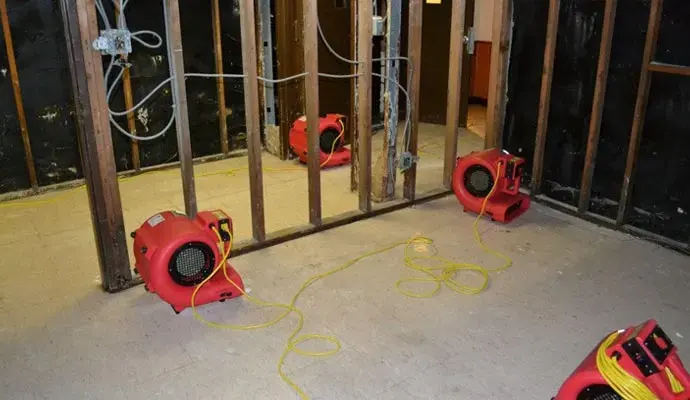
Standard
IICRC S500
Goal
Within 2 to 4 points of dry reference
Typical time
Three to five days, contained loss
Records
Daily moisture and psychrometric logs
Do this first
First moves when you find structural drying
- Keep doors closed Closed rooms let dehumidifiers work efficiently.
- Leave the equipment running Turning it off resets the progress.
- Keep the heat on A warm room dries faster in winter.
- Do not paint or patch yet Sealing a wet wall traps the moisture.
- Ask for the readings The daily log shows where each area stands.
Typical cost ranges
What does structural drying and dehumidification cost in Rochester, MI?
In Rochester, MI, structural drying and dehumidification typically runs $1,500 to $10,000. The drivers are the water class, how many rooms are drying, the materials involved and how many days the equipment has to run.
One room, Class 1 to 2
$1,500 to $3,000
- Air movers and LGR
- Daily readings
- Three to four days
Several rooms or a basement
$3,000 to $6,500
- More equipment
- Cavity drying
- Psychrometric logs
Class 4, dense materials
$6,500 to $10,000+
- Desiccants
- Hardwood mats
- Extended monitoring
Every loss is priced on its own facts. Run the water damage cost calculator for a planning range before the walkthrough.
The work, step by step
How structural drying is handled in Rochester, MI
- 1
Map and reference
The tech who does the walkthrough maps wet materials and takes dry reference readings.
- 2
Size the equipment
The drying team sets air movers and dehumidifiers to the class of water.
- 3
Log every day
Temperature, humidity, grains per pound and material readings go in the log.
- 4
Pull on the numbers
Equipment comes out when every material reaches the drying goal.
Structural drying is the part of a water job that decides whether the problem comes back. Wood framing, subfloor, drywall and concrete all hold water inside them, and until they give it up the house is not dry, whatever the surface looks like.
What goes into a structural dry-out
- Moisture mapping before any equipment goes down, with pinless meters, pin meters and thermal imaging
- A dry reference reading from the same material in an unaffected part of the house
- Air movers set to the evaporation load of each room
- LGR dehumidifiers that pull moisture out of the air even as it gets drier
- Desiccant dehumidifiers for dense Class 4 materials like hardwood, plaster and concrete
- Injection drying and floor mats for wall cavities and hardwood
How the drying team runs it
The water class sets how much equipment a room needs. Class 1 is a small, low-porosity area; Class 4 is water bound in dense materials. The drying team sizes air movers and dehumidifiers to that class, then records temperature, relative humidity and grains per pound inside and outside the drying area every day, along with readings at each marked point.
Equipment gets moved or adjusted as areas dry, and it comes out only when every material reaches its goal. In Rochester basements the concrete slab is usually last, which is why a finished lower level often takes a day or two longer than a room upstairs.
Trade fact: the drying goal is a reading within 2 to 4 points of the same material in a dry part of the house, and that comparison, not a calendar date, is what ends the job.
Why the logs matter
Daily moisture and psychrometric readings show an adjuster that the structure really dried and why equipment stayed as long as it did. They also protect you if you sell the house later. The EPA moisture control page explains why drying within 24 to 48 hours matters, and the FEMA flood insurance page covers flood claims. Extraction, the step before drying, is on the water extraction page.
Service area
Structural Drying and Dehumidification across Rochester and Oakland County
The restoration team covers Rochester and Rochester Hills across ZIP codes 48306, 48307, 48308 and 48309, from downtown Main Street and North Hill to Brooklands, Oakland University and the Oakland Township edge, plus Shelby Township, Auburn Hills, Lake Orion, Troy and Utica.
See every area and ZIP coveredRelated
Related water damage services in Rochester
Questions
Structural Drying and Dehumidification questions in Rochester, MI
1What is the IICRC S500?
It is the industry standard for professional water damage restoration. It sets how water is categorized, how drying is planned and how completion is verified.
2Why not just use fans?
Fans move air across a surface. Without dehumidification the moisture stays in the room, and without readings nobody knows when the framing is actually dry.
3What is an LGR dehumidifier?
A low grain refrigerant dehumidifier that keeps pulling water from the air even as the air gets drier, which a household unit cannot do.
4How long does structural drying take?
A contained Class 1 or 2 loss usually dries in three to five days. Hardwood, plaster and concrete take longer.
5Can I turn the equipment off at night?
It is best not to. Drying depends on steady airflow and dehumidification, and stopping resets progress.
6What is a dry reference reading?
A reading of the same material in an unaffected part of the house. The goal is to bring the wet material within 2 to 4 points of it.
24/7 emergency dispatch
Structural Drying and Dehumidification in Rochester? Start the dry-out now.
Water that sits keeps spreading into subfloor, drywall and framing. The Rochester restoration crew handles structural drying 24/7 across Rochester and Rochester Hills.